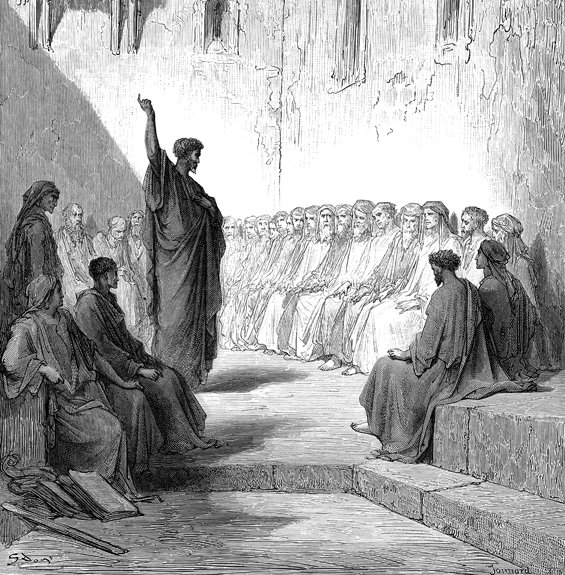
The testimony of honest men
Some reasons for trusting the Gospel accounts
In the last two articles on the "lunatic of Galilee", I've offered a treatment of the Lewis trilemma, and explained why I don't find it credible that Jesus was a liar or a lunatic. Naturally, this trilemma rests on Jesus's words really being Jesus's words, and not somebody else's. In this article, I defend that proposition: I think we have very good reasons to believe that the words of Jesus (and other things) relayed to us by the New Testament are genuine, and can be taken as evidentially sound.
This isn't a comprehensive apologia on the topic, by any means; the body of evidence given in defence of the Gospels' historicity is immense, and I can only treat a small segment of it here. It is more of an account of the flaws in the arguments I have heard against the historicity of the Gospels, and the faulty assumptions in the thinking and attitudes behind those arguments. All too often it's taken for granted that, where the New Testament is concerned, we can't trust what we read; here, I lay out some reasons to be sceptical of our scepticism.
This article ended up being considerably longer than anticipated. I had initially intended to write only a couple of thousand words; before long I had written more than five thousand, and had to wonder if perhaps I should split it into two parts, as I had done with the last two. I decided against it; I think that the argument is more compelling this way. Be prepared for a long read!
Is it really a trilemma?
We have considered the words of Jesus at some length, and weighed their implications for the Lewis trilemma: in my estimation, they make the naturalistic options very unlikely, and push us strongly in the direction of his divinity. At this juncture, there are two typical responses offered by the sceptic. The first would be something to this effect: "the option you're taking- 'Lord'- isn't credible because you're just assuming God exists." An accusation of question-begging or circular reasoning might follow. Now, before giving a more detailed answer, I must note at first that the issue can be reversed very easily: you're only denying the obvious conclusion because you're assuming God doesn't exist. Both of these charges carry equal weight (though I don't think that weight is very substantial in either case); this suggests to me that they don't offer us any clarity on who has the right of the issue. But I think this misses the real problem with the objection. The apologetic value of the trilemma lies in excluding the two mundane options- liar and lunatic- to force us to attend to the third, supernatural option. If we cannot account for the words and deeds of this man on a natural basis, then does this in itself not suggest that the answer lies beyond the natural, and serve as evidence that God does exist?
This is very similar to the issue of miracles. When confronted by stories of the scientifically impossible, we have a very strict trilemma: we are being told either lies, mistakes, or the truth. There is no fourth option. To give an example: I know a man who, on mission to South-East Asia, saw a visibly deformed arm restored to full working order through prayer. If he was not telling me the truth about this, then either he was lying to my face, or he was honestly mistaken. I have no reason whatsoever to believe either alternative: he is one of the most honest, upstanding, clear-headed men I have ever met. I am therefore compelled to believe, in the absence of sound evidence to the contrary, that he was telling me the truth.
This brings us to the second, and more potent, response. This would be the claim (which I alluded to in my first post on the subject) that the trilemma is not a trilemma at all, but a tetralemma: there is a fourth option, which is "legend". Jesus Christ did not really say any of the things the Gospels claim he said; the words were put into his mouth by later authors who were happy to invent things for theological purposes. Perhaps my friend's testimony, given that I can attest personally to his trustworthiness, cannot easily be dismissed; but we are hardly in that position with any of the books of the New Testament. We cannot trust what we read in the Gospels, because the authors were motivated to fabricate and exaggerate. This, I find, is the option taken by the majority of critics: a total, no-holds-barred hyper-scepticism, which denies the historicity of virtually everything in the New Testament. It accords quite nicely with the widely-held (though erroneous) belief that all religious authorities are sinister, Orwellian entities who are constantly rewriting history and altering the truth to suit their aims.
At first glance, this response may seem plausible. After all, it happened so long ago, and all tales grow in the telling, and doesn't it just make sense that the authors of the Gospels would massage the facts as expedience required? In my experience, however, it doesn't take long before this hypothesis starts to lose its shine; as appealing as it might sound in the abstract, it struggles to account for the actual, concrete realities of what we read in the New Testament.
The problem of genre
As we are dealing with criticism of the Lewis trilemma, I feel it would be appropriate to start with some input from the man himself. Critics of the trilemma, trying to make the case for a fourth "legend" option, fail to appreciate that Lewis saw this coming some distance off. You can find his full thoughts on the matter in an excellent essay entitled "Fern-seed and Elephants"; I will only treat a brief section here, though I would encourage anyone, believer or sceptic, to read the full essay (see below). The thrust of his argument is that the Gospels are clearly not written as legends: we have ample cases of legendary literature which survive to us from this time period, and the Gospels look nothing like any of them. As he puts it:1
I have been reading poems, romances, vision-literature, legends, myths all my life. I know what they are like. I know that not one of them is like this. Of this text there are only two possible views. Either this is reportage- though it may no doubt contain errors- pretty close up to the facts... or else, some unknown writer in the second century, without known predecessors or successors, suddenly anticipated the whole technique of modern, novelistic, realistic narrative. If it is untrue, it must be narrative of that kind. The reader who doesn't see this has simply not learned to read.
The attempt to escape from the trilemma requires that we read the Gospels as relating legend: the events in question did not happen, but have been built up over time to suit certain theological ends. However, as Lewis points out, it is not tenable to read them as any kind of legend. They are so prosaic as to be almost clumsy, prone to making unexplained allusions and including irrelevant details. The style of writing most similar to what we find in the Gospels is that of the modern novel, which seeks to build realistic scenes through the use of descriptions which are superfluous to the narrative. The problem (and it is a considerable one) is that this genre of narrative did not exist in the first century. This leaves us in a bind: if the Gospels are not endeavouring to report facts, then they must fall into a category of literature which wouldn't exist for more than a thousand years. I find a very clear example of this in John's account of the Resurrection:
Now on the first day of the week Mary Magdalene came to the tomb early, while it was still dark, and saw that the stone had been taken away from the tomb. So she ran and went to Simon Peter and the other disciple, the one whom Jesus loved, and said to them, “They have taken the Lord out of the tomb, and we do not know where they have laid him.” So Peter went out with the other disciple, and they were going toward the tomb. Both of them were running together, but the other disciple outran Peter and reached the tomb first.
John 20:1-4
You do not need to be a born-again Christian to appreciate this point. Consider the centrality and supreme importance of the Resurrection in Christian thought. Reflect on the gravity which this doctrine holds in the Church. Perhaps you don't believe it yourself, but you can imagine the profundity of it for those who do. This is the Resurrection: the defeat of death, the salvation of the human race, the decisive blow struck in an age-old war against cosmic evil. With that in mind, ask yourself: why on earth is the author, in the midst of relating this most momentous of events, bragging about having beaten Peter in a foot race?
It's the sheer silliness of the episode which persuades me. I cannot think of any reason for inventing it, particularly not one which would serve any kind of theological purpose; on the contrary, I think I can detect in it a measure of personal pettiness. John intended to record for posterity that he was faster than Peter. It is all too understandable; of course, in setting down his recollections of that time, he would take the chance to get one over on his old friend (and sometimes rival, I am sure). I feel it adds a human touch to the narrative. On the hypothesis that John's Gospel is principally meant to relate legend, this becomes inexplicable; perhaps that is because this is not what John's Gospel is intended to do.
The accountability of the Church
There is a corollary to the genre problem mentioned above. Often, in these discussions, it is taken for granted that the Early Church felt that they could invent things about Jesus for theological purposes. Perhaps it is because it is assumed so frequently that it seems so rarely challenged; in any case, if I were permitted only one challenge, I would make it to this point. I do not think there is even a shred of evidence that the Early Church felt they were at liberty to do this; furthermore, I think that on this matter, the burden of proof lies squarely on the sceptic. The accusation that the Early Church were happy to make up stories when convenience demanded is a serious one, and it needs to be backed up by a strong body of evidence; certainly it should never be assumed, if for no other reason than that the historical evidence available to us points in the opposite direction.
It is easy for modern readers (even nominally Christian ones) to forget that Jesus was a rabbi, and that the first Christians were his disciples. This means that they were part of a formal, well-established tradition of teaching and learning; crucially, within this tradition, the very last thing a disciple could do was to put words in his rabbi's mouth. It was a disciple's responsibility to accurately pass on the teachings he had received. He was allowed to translate, to paraphrase, or to condense, but never to fabricate; that would have been a grave dishonour to his rabbi. The same goes for inventing stories as for inventing sayings; it simply was not part of the tradition, which emphasised fidelity to the teaching inherited above all.
One witness to this is the controversy which arose very early in the Church's life over the circumcision of Gentile converts, which is the matter on which St. Paul wrote to the Galatians. I haven't the space to look at this matter in depth; suffice it to say that this was a formidable problem for the Church and it was fiercely debated. It did not bring out the best in St. Paul, who famously wished that the members of the circumcision party in Galatia would go and ἀποκόψονται themselves (Gal. 5:12; look it up!). Crucially, it occurred while the major figures of first-generation Christianity- Saints Peter, Paul, John, and James (Lesser and Greater), for example- were very much alive and ministering.
If we are going with the sceptical hypothesis- that the Early Church was happy to fabricate material about Jesus when expedient- then this is exactly the scenario in which they should have done it. All it would have taken was one saying which sounded suitably Messianic, and the matter would have been settled. Instead, the leaders of the Church were forced to delve into the theology and mystery of the Atonement, and ponder what bearing this strange event could have on the requirements of the Law; that is, they actually had to think, and do some serious theologising about the implications of what they believed. To me, this clearly demonstrates that they did not feel at liberty to invent anything. Absent from this entire episode is any trace of "theological licence"; what we see from this period of the Church's history is a sense of utter accountability to events already fixed as historical fact, though their full implications required deep contemplation.
The notion that anything in the New Testament is the product of wilful, knowing fabrication is, to my mind, nothing more than question-begging. It is a case of assuming the very thing we are supposed to prove, and proof of this claim is not forthcoming. The example of the circumcision controversy is very revealing in this regard. It forces the proponent of this hypothesis to explain why, on their view, the Early Church could have fabricated a clear and decisive solution to their problem, but didn't. As far as I can see, we have two options. Either, having the latitude to invent sayings of Jesus, the Church actively chose not to, or they had no such latitude and were ethically and theologically bound by a higher truth. Both options are ultimately fatal to the argument.
Controlled transmission
Related to the matter of accountability is the question of how the contents of the Gospels were transmitted. There is an interesting phenomenon I have noticed among sceptical arguments against the reliability of the Gospels: I often run into the belief (or some variant of it) that the Gospels were the first definitive word on the matter of Jesus Christ after decades of near-silence, as though nothing much was said about the man's ministry, death, or resurrection until the appearance of Mark's Gospel, sometime between 65 and 75 AD; I once heard it compared to an author in 1980 trying to recall something Winston Churchill had said during the Second World War. There seems to be a widespread misconception that the Gospels introduced the Son of God to the Christian world as a novelty. Parallel to this is the notion that the Gospels were produced by a process resembling Chinese whispers (or the "telephone game", for any readers across the pond). I am surprised at how many people find these ideas plausible, and are happy to repeat them in arguments; in any case, the reality is quite different.
I think it would be appropriate to start by pointing out that the early Christian belief in the resurrection of Jesus Christ from the dead is not something that developed over time; it is present ab initio, from the earliest apostolic testimony. The resurrection of Christ is Christianity's ground zero. This is a surprisingly uncontroversial assertion in scholarship; it is a point of academic consensus that Jesus's disciples earnestly believed that they had seen their rabbi resurrected from the dead, and preached to that effect. As the esteemed New Testament scholar Gary Habermas puts it:2
The substantially unanimous verdict of contemporary critical scholars is that Jesus' disciples at least believed that Jesus was alive, resurrected from the dead.
That is, they were not lying; the disciples testified to something they had actually experienced. We may take their honesty as a matter of solid historical fact, on par with Julius Caesar's crossing of the Rubicon. This gives us a strong apostolic core for the historicity of the Gospel accounts; we may be absolutely sure that the first Christians told the truth (or at least didn't lie). But what of the intervening years? Don't all stories become distorted as they are told and retold over time? Some may do- but not all stories are told in the same way. It may, at first glance, seem plausible to compare the early Christian kerygma (proclamation, or preaching) to a game of "Telephone", in which each successive listener doesn't quite hear the message correctly and relays an increasingly-inaccurate version of it to the next person in the chain; however, this view is an anachronism, and should not be taken seriously.3
The telephone game, in this case, is an example of an uncontrolled oral tradition- nobody takes any care to make sure that what's been relayed to them has actually been received and understood properly. This is virtually the exact opposite of how knowledge was actually transmitted in the cultural-historical context of the Early Church. The message of the Gospel was passed down initially through a controlled oral tradition, one in which there was a constant back-and-forth of confirmation, elaboration, explanation, and source-checking. St. Paul testifies to this in his letter to the Corinthians:
For I delivered to you as of first importance what I also received: that Christ died for our sins in accordance with the Scriptures, that he was buried, that he was raised on the third day in accordance with the Scriptures, and that he appeared to Cephas, then to the twelve.
1 Corinthians 15:3-5
As the New Testament scholar James P. Ware notes (in an excellent book which is written as much in Koine Greek as it is in English), Paul is using technical language: the words "delivered" (παρέδωκα) and "received" (παρέλαβον) denote a formal, organised system of transmission and reception.4 Peter did not whisper something vague about an empty tomb in Paul's ear and then send him off to Anatolia; rather, Paul would have undergone a process of catechesis, or instruction, during which his catechist could make sure that Paul understood what he was being told, and Paul himself could clarify what he didn't understand by asking questions (and Paul strikes me as a man who had a knack for asking the most annoying questions). This process would have acted as a very effective safeguard against the kind of distortion which is so often assumed, without evidence, to have occurred.
Thus, by the end of his catechism, Paul would have known exactly what the apostles believed and taught about the Resurrection, and could have told you in great detail about the chain of transmission (which at that point would have been very, very short- perhaps only one or two people). This process would have continued in every missionary trip which Paul conducted, only with himself as the catechist: he would have ensured, with the kind of obsessive attention to detail that might be expected of a former Pharisee, that those people whom he evangelised had understood what they'd heard, and were suitably prepared to share it with other people. This made the kerygma of the Church very well-entrenched against corruption.
The primacy of tradition
The security of the oral tradition by which the Church received the apostolic testimony is, I think, good evidence in and of itself; but there is one last point to make on this subject, and it is an important one. When at last the Gospels were committed to papyrus and begin to circulate among the churches in written form, they had to match the oral tradition. Consider, for a moment, what would have happened if any of the four Gospels testified to a radically different version of Jesus than what had been already been received: they wouldn't have been accepted, because they were at variance with the more authoritative tradition. There had to have been broad congruence between the oral and written testimonies of Jesus's life, or else the latter, newer testimony would have been discarded in favour of the former and older one.
Interestingly, this is precisely what happened with the so-called "apocryphal gospels" which bear names like Thomas and Mary and Peter, and which we read about in the abominable Da Vinci Code (no, I will never miss an opportunity to rubbish Dan Brown's work, given that it is best-selling rubbish which has caused more popular-level confusion about Christianity than almost anything else published in the last hundred years, and it doesn't even have the defence of being well-written). The popular narrative that these books were removed from the New Testament canon by a censorious Church is profoundly misleading. The truth is that they were recognised almost immediately by the theologians of the Church as forgeries. The apocryphal gospels gave themselves away by their apparent lack of familiarity with the Old Testament, as well as their insistence on Jesus's having passed on secret teachings which were known only to enlightened initiates (a hallmark of Gnosticism, a later heterodox development).5 Most damning, however, was their total lack of apostolic pedigree; not only were their contents wildly at variance with what the Church had already received, but they could provide no valid chain of transmission, either.6
Here we see the dynamic at work: any new entrants to the tradition had to line up with what already existed, or else had to provide some very authoritative credentials. Works that could do neither were discarded. Evidently, the four Gospels of the New Testament passed this test: either they closely corroborated what the Church had already received from the Apostles, or they were of such clear and authoritative provenance (likely no more than one degree removed from the Apostles themselves) that nobody could dispute them. Perhaps it was both (I am inclined to think so); in either case, the notion that the canonical Gospels could have been invented wholesale by unknown authors and peddled fiction to the Church has gone entirely out the window. It defies any historical credibility.
Inconvenient truths
I appreciate that this is already a long article, but there are two final points of evidence that I would like to consider. The first point concerns the actual descriptions of the Resurrection which we find in the Gospels themselves: crucially, the fact that all four of them record that the empty tomb was discovered by women. Now, in our present egalitarian age, we may not take much note of this fact; in the first-century Mediterranean world, however, this would have been a scandal. Women's testimony was considered much less credible than men's testimony, and in some cases was not even admissible in court.7 To rely on a woman's word for support on a contentious issue was very much a faux pas; you would only discredit your position by doing so.
On the hypothesis that the Gospels were fabricated by people who knew their contents to be fictional (but nonetheless wanted people to believe them), the decision to have the empty tomb discovered by women is inexplicable. The authors would have been deliberately undermining the credibility of what they were writing; it would have been so easy to swap out Mary Magdalene for Peter, or John, or any of the other disciples, and sidestep the problem. That is not what happened. Instead, for some reason, all four Gospels insist that the first eyewitnesses to the empty tomb were women. There is only one reason for this that makes sense of the data: the authors of the Gospels were relating what they genuinely believed to be true, even though it was inconvenient. This is the hallmark of honest, trustworthy testimony: it stands by the truth even when it may prove harmful.
The second point concerns martyrdom. Liars, it has been said, make poor martyrs. For the minor apostles, we have no reliable historical record of what happened to them after the end of the Book of Acts (this is likely because they died in poverty and near-anonymity in countries not their own); the record for the major apostles, however, is much better. I want to focus here on Peter and Paul, who were at the very heart of the early Christian movement. It is very likely that both of them were martyred during the Neronian persecution, in or around 64 AD;8 their martyrdoms are attested to by first-century works outside of the New Testament, such as St. Clement's letter to the church in Corinth.9 When the historical evidence is fairly weighed against the hypothesis that the Early Church knowingly invented the stories and sayings of Jesus, a serious problem emerges: we are being asked to believe that these two men were prepared to die for something they knew to be untrue.
I have pointed out this problem in discussions before, and, without failure, plane-hijacking jihadists are immediately brought up as though they represent a valid counter-example. This is not a valid counter-example; it is a red herring. I gather anecdotally that this is a notoriously common occurrence. Perhaps the people who bring this up have met other apologists who have framed the argument from martyrdom clumsily; even so, it does not excuse the failure to understand the issue. The argument is not "Peter and Paul were martyred, therefore what they believed was true." It is not even "Peter and Paul were martyred, therefore what they believed was evidentially compelling". The argument is this: "Peter and Paul were both in a position to know definitively whether Jesus Christ rose bodily from the dead. People, as a rule, are not prepared to die in the defence of propositions they know to be false. Peter and Paul were both prepared to die in the defence of the proposition that Jesus Christ rose bodily from the dead; therefore, we have good reason to believe that Jesus Christ rose bodily from the dead."
The distinction here should be clear. The terrorist who commandeers an airliner is not in a position to know whether what he believes is true; he may have his convictions, but ultimately those things which motivate his martyrdom have never crossed into the realm of propositional knowledge. Perhaps, as he hopes, he will be met by the dark-eyed houris, and spend eternity in an ecstasy of deflowering; perhaps he will cease to be, and will not be around to remember that he ever existed; or perhaps, as I suspect, he will wake up into an unending nightmare. He does not know which. No matter how strongly he may believe, he cannot claim to know for certain. Here is the crucial difference with the apostolic martyrs: this is exactly what they could claim. For Simon Peter, and for Paul, the question of whether Jesus Christ rose from the dead was not merely an article of faith, but something they claimed to know for a fact. For them, it was not a belief, but a memory of an experienced reality, something of greater import than had ever happened to them. As Paul has it:
...he appeared to Cephas, then to the twelve. Then he appeared to more than five hundred brothers at one time, most of whom are still alive, though some have fallen asleep. Then he appeared to James, then to all the apostles. Last of all, as to one untimely born, he appeared also to me.
1 Corinthians 15:5-8
This is the testimony of Paul; he was prepared to die for it. He was certainly not lying, and I struggle to understand how he could possibly have been mistaken. Perhaps we should seriously consider that he was telling the truth.
Fording the river
This brings us, at long last, to the conclusion of the article. This has been my attempt to show the implausibility of "legend" as an option in the aforementioned tetralemma; there is simply too much evidence that stands in the way of it. This is by no means the extent of the evidence, either; I have included some resources below that I think any reader, whether a believer or a sceptic, will find useful. I particularly recommend Michael Jones' series on the reliability of the Gospels.
So, some words in parting. Where does this leave us? The Gospels, as best I can see, represent the testimony of honest men. They are not written as myths or as legends, but as reportage. The first Christians genuinely believed that Jesus Christ had risen from the dead; they were honour-bound to tell the truth about their beloved rabbi, and would not have disgraced him or themselves by lying. The tradition by which they handed down their testimony is robust, time-tested, and trustworthy. The four Gospels, when they were written, had to line up very closely with the pre-existing oral tradition, or demonstrate their authority beyond reasonable doubt; if they could do neither of these things, they would not have been accepted by the Church. Lastly, the authors of the Gospels take pains to include material which was damaging to their case; and of the two men who would know better than almost any others whether Christ had indeed risen, both were prepared to surrender their lives to the affirmative.
I think (and I am far from alone in this) that this is a standard of reliability to which we could not hold any other work in classical antiquity. I do not think that Suetonius's 12 Caesars could match it, nor Tacitus's Annals of Imperial Rome; yet neither of these works face anything like the total, indiscriminate scepticism to which we routinely subject the works of the New Testament. It seems to me that anyone who is happy to dismiss the Gospels as ahistorical has not, so to speak, counted the cost; if we cannot trust the Gospels, then we cannot trust anything written about anything for several hundred years in either direction. Throw out the Resurrection, and you must be prepared to throw out virtually everything we think we know about the classical period.
With this in mind, I return to the trilemma, for it is a trilemma: as with strange stories of miracles, there is no fourth option. There is no "out" and no safe retreat. The Christ who meets us in the Gospels is piercingly, unerringly real. His words- those bewildering and beautiful words that have endured for two thousand years- are indeed his. The love and the fury and the sorrow and the joy, the brilliance and the unreachable depths of mind, the nobility balanced so precisely against humility, the strength matched so perfectly by tenderness, the unshakeable sense that maybe, in this one man, we see all that humanity was meant to be: all those are his. They are the impression left by a real man who could do impossible things.
For further consideration
"Fern-seed and Elephants", as mentioned above:
Electronic copy
In audio form (very pleasant to listen to!)
An electronic copy of the Gary Habermas article I referenced (surprisingly readable for an academic publication):
Experiences of the Risen Jesus
Michael Jones’ excellent (and very well-sourced) series on the reliability of the Gospels:
Inspiring Philosophy | The Reliability of the Gospels
Peter Kreeft on the evidence for the Resurrection:
Peter Kreeft | Evidence for the Resurrection of Christ
Some of Jonathan McLatchie's work on this subject (I highly recommend his blog):
The Resurrection of Jesus: The evidential contributions of Luke-Acts
The Evidential Value of John’s Gospel to the Case for Christianity
Liar, Lunatic, or Lord? Reviving C.S. Lewis’ Trilemma
Some very good contemporary research on the realistic distribution of names in the Synoptic Gospels:
New Testament Studies | Name Recall in the Synoptic Gospels
All Bible citations are from the English Standard Version unless specified otherwise.