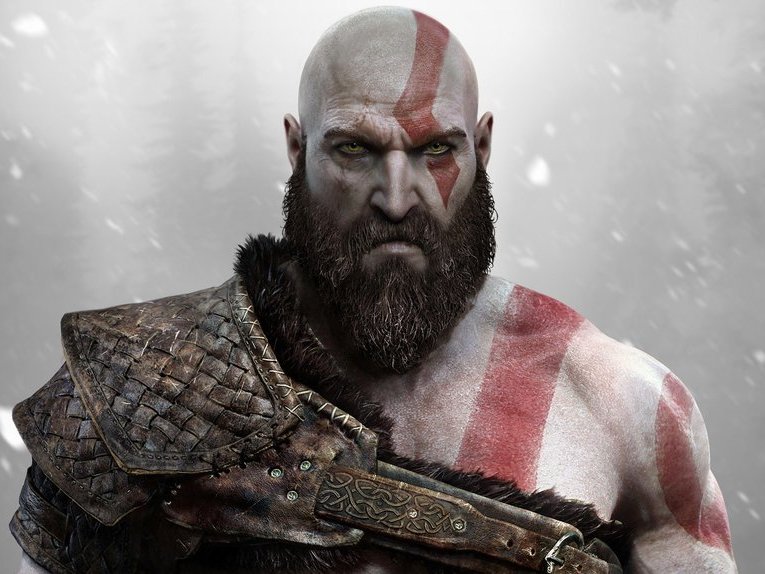
Deicide and redemption
Theological reflections on God of War (2018)
Not too long ago, I found myself watching the end credits of 2018's God of War, thinking "this game was better than it had any right to be." This was not a game which required all that much in the way of reflective storytelling; its developers did not need to go too far beyond "a big, angry Greek goes to the frozen north with an axe", and it would have been more than entertaining enough. When first I sat down to play it, my expectations were not set overly high: I anticipated a few hours' worth of hacking and slashing through enemies of steadily-increasing difficulty, with a dash of puzzle-solving in between, glued together with a storyline that might plausibly explain what was happening if you didn't think about it too hard. I wasn't wrong an all counts; there was a great deal of (immensely satisfying) hacking and slashing, there were puzzles, and the storyline did require some suspension of disbelief. All that said, the whole was much greater than the sum of its parts, and not even very long into the game I realised it had easily defied my expectations; it serves me right for being a cynic.
This is a genuinely impressive game. There are many separate aspects which contribute to that: the spectacular design of its levels and characters; the score, all brooding drums, mournful strings, and haunting Norse vocals; perhaps most of all, the masterful portrayal of the dynamic between Kratos and Atreus. The story has gravity without melodrama, and it manages some moments of levity without devolving into silliness. Its action is decidedly absurd and over-the-top in parts, but somehow it manages to pull this off without breaking the spell. As I explored the cliffs and vales of Midgard, bringing excessive force to bear against monsters of Scandinavian legend, I found myself reflecting on the world the developers had created. Given that the protagonist is a god, the subject matter of the game is inherently theological. Granted, some of that theology may be tongue-in-cheek, but it is no less worth considering for that. Here I will lay out some of the reflections which have come to mind concerning Kratos, Atreus, and their quest for solace in the wake of bereavement.
A note to anyone who has yet to play the game: in this article I will be treating key events from the game's story, including its conclusion. Spoilers will follow; you have been warned!
Gods who bleed
All good theology must involve definitions. The word "god" is decidedly loose in its meaning, and this tends to hold true across languages. The Hebrew word elohim, which is most commonly rendered as "God" in the Old Testament, can refer to a number of things other than the uncreated Creator of the universe, up to and including the departed souls of dead mortals;1 similarly, the Greek term theos encompasses a broad range of nuances in the kinds of divinity it describes, and is sometimes interchangeable with daimon, the root of the English "demon".2 "God" may mean a transcendent Platonic ideal which calls to mind a glowing orb; it may mean any of the raunchy and impulsive Olympians one finds in Homer or Hesiod, who seem to be ruled by their passions and never forget an insult; it may mean something closer to a principle than to a person, such as the philosophies of Kant, Spinoza, or Leibniz would suggest; or it may mean the very opposite, the utter extreme of being and personhood that we meet in the Abrahamic faiths, a fearsome and nigh-unknowable consciousness that was there in the aeons of measureless time before the Earth was formed and will still be there, watching, long after the sun has gone cold. What, within this particular mythos, is a "god"?
The first thing to note is that, in this world, gods can be killed. They are not wholly immortal; they can certainly take a great deal of punishment, but, as we discover in the game's finale, apply enough force and their necks will snap. Kratos's confrontations with the Aesir often leave him bruised, bloody, and exhausted; his face and torso are cross-hatched with the marks of old wounds, and there is a scar on his abdomen from what must have been a horrific injury. He wraps his forearms in bandages to conceal the brands left by burning chains; throughout his journey, there are moments at which his strength seems to have all but drained away, and with laboured movements and grunts of pain he must draw upon the dregs of his willpower to continue. Kratos's godhood is a thing with hard limits.
There are purely mechanical reasons for this, of course; it would not be a worthwhile game if he could not die. The game's whole appeal lies in the struggle to overcome adversity. Without this there would be no quest, no adventure, and no reward. Kratos's struggles are meaningful only because he is vulnerable. There are moments in this game (though such moments are far from unique to this game) where you may suddenly find yourself wandering into an area beyond your level; undeterred, you explore a little further, only to catch the attention of something which then proceeds to kill you with a single blow. Despite the inconvenience, I have always found moments like these appealing. They speak to potential; I may not be strong enough now, but at some point I will be. This is what makes it so immensely satisfying to return when you are at last strong enough- when you can absorb much more damage, and deal more yourself- and conquer the enemies which had previously conquered you.
That said, I think there is a deeper necessity than simply the game mechanics. Games (and books, and films, and more besides) which make use of this dynamic are enjoyable precisely because they imitate something essential to life. For whatever reason, it seems as though we are built to seek out adversity and overcome it. We have a triumph instinct, so to speak. Growth and transformation are only possible in the presence of opposition. From a theodicean perspective, this is one of the reasons why moral and natural evil exist in the world: if they did not, then we would remain in a state of eternal, meaningless stasis. We would never grow, never achieve anything, and never become better than what we are. Art and media which do not respect this fundamental need become boring very quickly. Everyone's favourite squeaky Albertan psychologist, Jordan Peterson, puts it this way:
A superhero who can do anything turns out to be no hero at all. He's nothing specific, so he's nothing. He has nothing to strive against, so he can't be admirable. Being of any reasonable sort appears to require limitation. Perhaps this is because Being requires Becoming, as well as mere static existence- and to become is to become something more, or at least something different. That is only possible for something limited.3
Now, the point which I would like to make requires that we avoid two traps. The first trap is to think that adversity per se is good, and to overlook the reality of trauma. I am not proposing anything of the sort. Certainly, the greater the challenge, the greater the triumph; but there are proper and improper challenges. This is the reason why crimes committed against children are so heinous. Trying to avoid this first trap, however, risks leading us into the second, which is to think that adversity per se is bad. Trauma can be overcome. A society which preoccupies itself with the eradication of all suffering will inevitably collapse; the people it produces will be weak, fragile, and useless. More than that, they will not be good. If all your needs are met- if you are fed, watered, sheltered, and not otherwise desperate- then the mere fact of abiding by the law of the land does not make you a good person. This is an important point, which I think is dangerously underappreciated. Most people are not good; they're just comfortable. They haven't been tested. Without temptations to sin, there can be no saints.
It is worth considering this with reference to Baldur, the game's principal antagonist, a god of the Aesir. In his first battle with Kratos, we learn that he cannot feel pain. As a result of an enchantment placed upon him by his mother, Freya, he is effectively invulnerable. To her, this is a blessing; she will have her son forever, safe from all harm, never to wither or die. To him, this is maddening and unendurable curse; we learn in subsequent encounters of his burning, murderous hatred for his mother, who stole from him everything that made life worth living. The moment the enchantment is broken, he becomes ecstatic: he can feel pain again. He has been readmitted into the realm of mortality. The only thing worse than suffering, it seems, is to be unable to suffer.
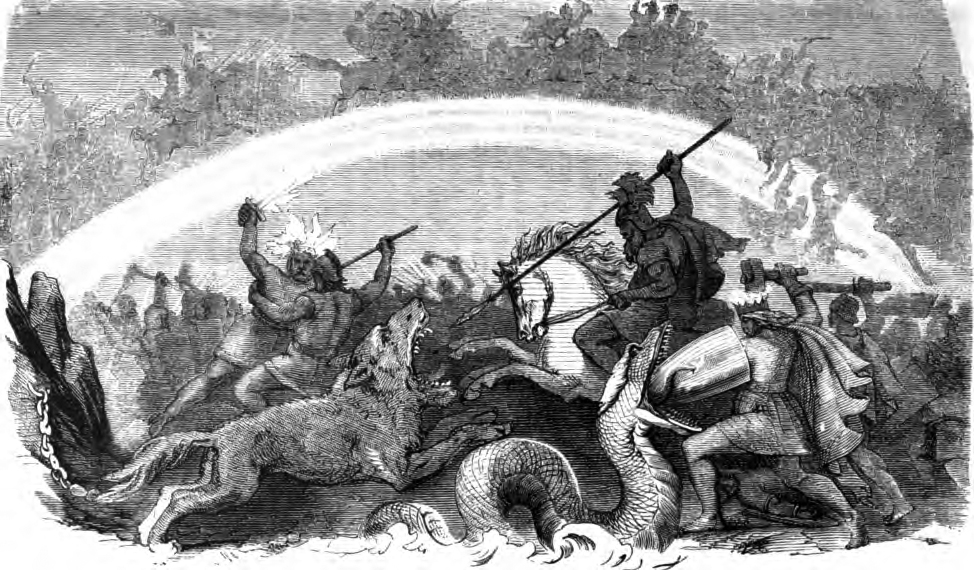
Battle of the Doomed Gods (Friedrich Wilhelm Heine, 1882)
War in the heavens
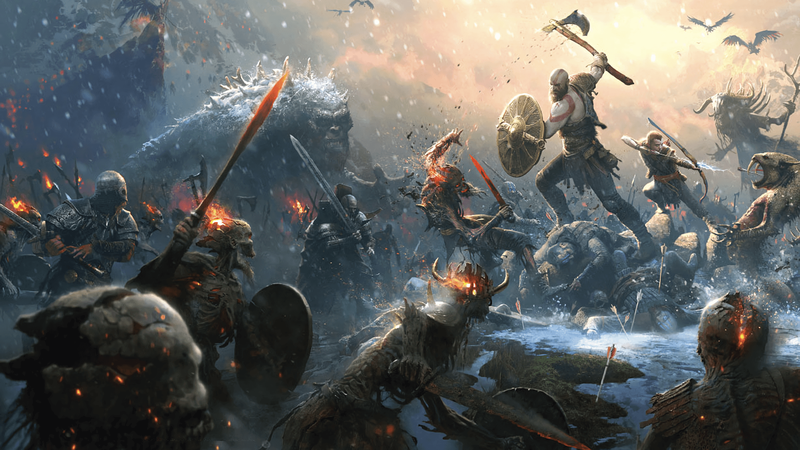
We have established that these are gods who bleed. The next thing to note is the context of cosmic strife in which we encounter them. Kratos and Atreus come to Midgard in the aftermath of a long, bloody series of wars. The landscape is littered with the corpses of felled giants, the remains of military outposts long since abandoned, and the ruins of great stone palaces where kings once dwelt and were overthrown. Throughout the game there are references to divine crusades of days gone by. We find triptychs engraved with scenes of battle from Norse mythology, and there is no shortage of subject matter. The gods go to war with the giants; among the gods, the Aesir go to war with the Vanir; when there are no more wars to fight, the Aesir are content to fight amongst themselves. Violent conquest is the overriding theme; Odin the All-Father seeks to set himself up as a cosmocrat, unopposed from any quarter, a ruler whose empire encompasses all nine realms.
The mythological context behind the game is very interesting, but here I will limit myself to what we learn from the game itself (though I've included a link down below to a very useful website on Norse mythology- give it a read!): the gods, though powerful, are fallible. Odin is a prime example of this. We never meet him in the game, but only ever hear of him. As you take your first steps into Midgard, you start to notice strange, spectral birds which seem to be following you. They look like crows, or ravens. They alight on nearby perches, watching you intently, before cawing and fluttering away. They don't seem to have a purpose; it is only later in the game that you discover that these are Odin's spies. As Mimir (a severed head with a Scottish brogue) explains, Odin is a paranoid, Herodian figure. He has become very powerful, and has succumbed to the mania for control which such power tends to cause. He searches out prophecies, particularly any which might foretell a challenge to his reign. His watchful corvids keep a close eye on any happenings of note. He is fixated on gaining access to the lost realm of Jotunheim; he has no particular reason, other than that he can't already get there.
This is all illustrative, as it demonstrates a very human fallibility. Odin labours under the tyrant's curse: he cannot rest, he cannot trust anybody, and he cannot change his ways. Though he has power, it is never settled, and is always vulnerable to treachery; even his closest confidant may, in a moment, turn into an enemy and bring about his downfall. If he wishes to maintain his rule, he has no option open to him but more tyranny. Odin's divine power, though magnified many times over from any earthly power, is qualitatively no different from that of a mortal king. It may be subverted, seized, usurped; Odin himself may be deposed by anyone sufficiently strong, or sufficiently devious. What we may take away from this state of affairs is that the divine realm is in disorder. It is being improperly ruled. Any semblance of true right to rule is just a thin veneer over brute strength; the All-Father enforces his will by subterfuge and force of arms. While order may be temporarily maintained, it will inevitably succumb to a countersurge of chaos, a dynamic illustrated in the Norse mythological imagination by Ragnarök, the great eschatological cataclysm where the entire world burns and all the gods are slain.
It should be mentioned here that this vision of a disordered cosmos bears a striking similarity to the "Deuteronomy 32 worldview" articulated by the late Michael Heiser; this is a cosmology originating in the Ancient Near East which holds that the gods of the nations are fallen principalities, which were once allotted to the peoples of the earth by the Most High, only to become corrupt and guilty of misrule.4 This would make Odin a viceregent of sorts, one who has abused his power and forgotten the nature of his appointment; as a consequence of his misrule, the domain for which he is responsible has descended into strife and decay. The consequences of this are apparent throughout Midgard. There is no real safety. Food is hunted rather than grown. Society consists not of habitable order, but of disparate bands of raiders and looters, each association short-lived and rife with betrayal. The sinister practice of seiðr- a type of sorcery, or black magic- abounds, often with fatal consequences for its practitioners. Most disturbingly, the dead do not stay dead, but return as bloodthirsty revenants to wreak revenge upon the living.
Into this disordered cosmos steps Kratos, a sojourner from a distant land with a history of deicide, or the murder of gods (though, in keeping with his Spartan heritage, "theoctony" might be a better term). We will revisit Kratos's own motives in the next section; here it will suffice to consider his place in the chaos. As long as we are entertaining Heiser's theology, I would contend that Kratos plays an essentially positive, even restorative role: though unwittingly, his actions are ultimately all in the service of restoring proper order to the cosmos. One of his principal undertakings is to purge the land of monsters; as one might expect, this involves dragon-slaying. Journeying through the heart of the mountain, he defeats the earthbound and terrifying Hræzlyr, who guards the path to the summit. This is not the only dragon in the game, however; there are a number of others who have been chained to the ground, and whom Kratos can opt to set free. These dragons are winged, and take immediately to the skies when their chains are broken, thereby returning to their proper domain; this, too, is part of Kratos's restorative role.
To this end, it is no accident that Kratos is not native to Midgard. As the realm has gone awry and its governing principalities have become wholly corrupt, it is only fitting that the solution should come from without. There are Biblical precedents to this. The inhabitants of the land of Canaan fall into the worship of dark powers, and the commission of all the unspeakable acts to which such things inevitably lead; after four hundred years of unrepentant evil, the Lord of Hosts raises up a foreign nation- the Israelites- to take over the land and put to an end the worship of Baal and Molech and Asherah. As the centuries go by, the Israelites themselves succumb to the same temptations; demonolatry begins to take bitter root, the blood of innocents is spilled in the invocation of sinister forces, and awful things happen once again in the high places of the Levant. And once again, the solution is exogenous: Jerusalem falls to the armies of Babylon, and the people of Israel are sent into exile. We may take Kratos's role to be similar: providence has brought to Midgard a slayer of gods from a distant land. Its inhabitants- whether human, monstrous, or divine- face judgement.
We must be better
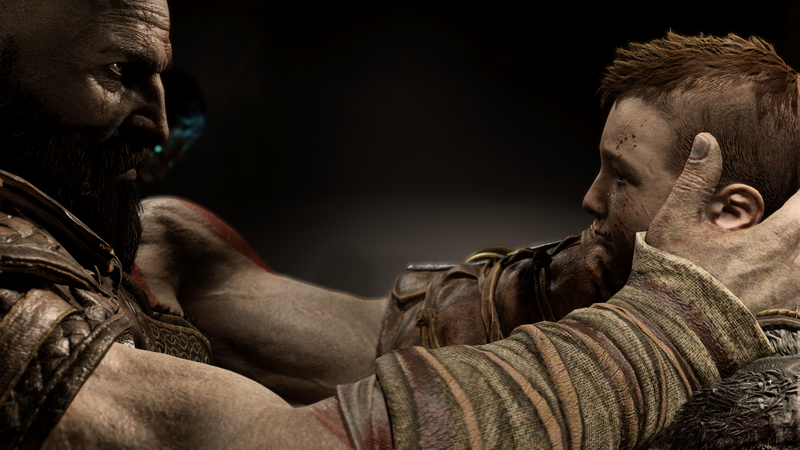
All this discussion of Kratos's restorative role must be taken with the proviso that it is not his conscious desire. Quite the contrary; the early chapters of the game make it clear that he does not want to embroil himself or his son in the divine affairs of the Norse world. For all his battles against gods and monsters, Kratos's most formidable enemies are domestic and personal: his grief at the loss of his wife Faye, and his struggle to understand what his young son Atreus needs from him. From a storytelling perspective, it is very easy to do such things badly, but I felt that the game pulled this dynamic off very well; as a consequence, the story draws most of its power not from the cosmic scale of events- gods clashing with gods- but from the familial motivations of Kratos and Atreus.
To illustrate this: much of the game's second half is spent in the attempt to reach the lost realm of Jotunheim. Why should we care about this place? It all comes from Faye's last wish: scatter her ashes atop the highest mountain in all the realms. At first it looks as though this mountain can be found in Midgard; scaling the summit, this turns out not to be the case, and thus begins the quest to rediscover Jotunheim. The role which Kratos plays in restoring order to Odin's fallen domain, as explored above, is essentially secondary; it happens only as a consequence of his pursuing a much less cosmically (yet far more personally) significant goal. It is interesting to imagine the counterfactual: perhaps if Kratos had started out with the intent of bringing order to Midgard, it would have come at the cost of his relationship with his son. I could see them drifting further apart as Atreus's simple desire- to lay his mother's memory to rest- becomes increasingly alienated from his father's entanglement with cosmic forces. It is not hard to imagine how this might end: Kratos subsumed by his self-appointed role as judge of the nine realms- perhaps knowing in the back of his mind that he chose the easier of two battles- and utterly estranged from his son, who gradually comes to regard his own father as the enemy.
Thankfully, this is not what happens. The role of Kratos as father, not Kratos as god-slayer, remains the beating heart of the story. This is not to say that those other elements are unimportant; however, their importance derives from how they affect the relationship between Kratos and Atreus. To give an example: for the first half of the game, Atreus does not know of his divine heritage. This causes a rift between the two of them from which tension springs: Atreus does not understand his father's apparent coldness towards him, nor his refusal to talk about his past. He takes this to mean that his father does not really care for him; all the while, he suffers alarming symptoms coming from the disjunct between his true nature and his own self-understanding, eventually reaching a crisis point and falling into a perilous coma. Thus, the whole concept of godhood becomes of interest to us because it is hurting Atreus, and straining his relationship to his father. The dynamic changes again when Atreus recovers, and Kratos tells him the truth: they are both gods. Divinity is a heavy burden to bear; Kratos had hoped to spare his son that burden by concealing the truth, but that proved impossible.
This disclosure changes the dynamic between them once again. Initially, Atreus reacts to the revelation of his godhood with boyish excitement: perhaps he has abilities he doesn't know about. This turns subtly and swiftly into entitlement: he doesn't have to care about the mortal inhabitants of Midgard, because he's a god, and their concerns aren't important. Soon, he begins to set himself against his own father: Kratos has no right to tell him what to do. They're both gods, after all. Kratos notes with mounting alarm the frequency with which his son disobeys him, ignores his instructions, questions his authority. Their relationship devolves almost to breaking point. This changes only after a catastrophe- the destruction of the last surviving entrance to Jotunheim- and a descent into the underworld, during which Atreus is forced to confront what he is becoming: a cruel and haughty being who cuts the throats of beaten foes in cold blood. From this point onward, he has to fight to find a new equilibrium. A common refrain in their conversations is Kratos's insistence that though the gods may have done wrong, they must be better.
Sins of the father
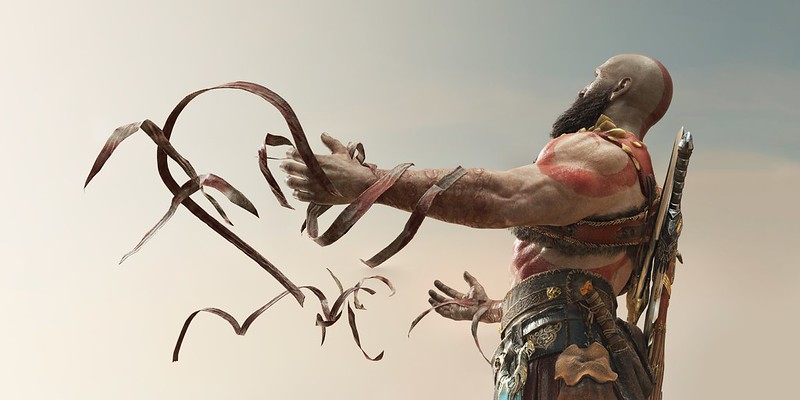
As all this is happening, Kratos must also confront his own past. The son of Zeus, he is laden with guilt for one of the greatest crimes a person can commit: parricide. He lives in the knowledge that he killed his father; it is little wonder that he struggles to love his son. This is aptly symbolised by the burn-scars on his forearms: these are the marks left by the weapons he used in his war against the Hellenic pantheon, which he conceals from Atreus by wrapping his forearms in old bandages. He cannot rid himself of the things he has done, and so he tries to hide from them instead, which leads in turn to his hiding the fact of Atreus's godhood. This latter concealment ultimately demands a reckoning; so, too, does the first. How is he to come to terms with the deeds of his past, and find redemption?
I would propose that the game's story, as it unfolds, provides two answers to this question. The first comes with the recognition that Kratos and Atreus cannot determine for themselves what is good, but must discern it instead. Kratos's hardness of heart- his unwillingness to let the brutality of the world affect him- is not his attempt at being a Nietzschean Ubermensch, whose morality is purely self-referential; it is only a defence mechanism. As much as the early chapters of the game may hint at a kind of Darwinian cosmos, in which the only good is survival and all means to that end are moral, I would contend that this is only in measured response to Atreus's sheltered sensitivity. Kratos must teach his son how to close his heart to suffering; he has to grow thick skin if he is to survive the harshness of Midgard.
However, this theme does not prevail; it is only a brief meditation, and not the story's core ethic. As the story develops, and Atreus learns how to hold his own in a fight, this dog-eat-dog aspect of the world fades in importance and does not predominate in conversation. Higher things take its place. By the time Atreus learns of his godhood, the tone of discussion has shifted to matters of ethics. Kratos sees the danger: unless his son is subject to some kind of greater moral obligation, then he will become a force of indiscriminate destruction. When he says "we must be better", this is what he means. They may be gods, but they are not God. They must exist under the auspices of a transcendental moral order; the alternative to this is a hell either of tyranny or anarchy. Interestingly, Atreus catches sight of this in the old stories of Tyr, who was loved and revered among the Aesir. He becomes fascinated with Tyr as an exemplar of martial virtue, moral integrity, and wise kingship; this mimetic admiration becomes a crucial component in his return to equilibrium.
The second answer is a practical instantiation of the first one's philosophical implications: Kratos, recognising the transcendence of the good, must break the cycle of fallen divinity. This starts with being the father he himself needed, and succeeding for Atreus where his own father failed him. He must tell his son the truth, particularly when it would be more expedient to lie or to hold silence. He must be there to guide Atreus when he strays from the path. If he wishes to lay to rest the guilt of his past, he must help Atreus not to make the same mistakes, and to be better than his father, as hard as that may be. He cannot do this purely by instruction; it must be embodied. If he wishes Atreus to be a better man- a better god- then Kratos himself must be better. He cannot erase his past, nor can he become other than what he is; but he may take those painful aspects of his nature and subordinate them as best he can in service to the good.
This is illustrated by the game's final confrontation with Baldur, in which Kratos kills him after a prolonged battle. Kratos has killed gods before; this time, it is different. Baldur has already been beaten and spared; thus Kratos shows his son the virtue of mercy. It is only when Baldur attempts to kill his mother, the goddess Freya, that Kratos delivers the fatal blow. In doing so, he prevents a matricide- a dark parallel to his own crime- and thereby embodies the proper role of the god-slayer. He has found, discerned, and understood the place and purpose of deicide; with this discovery, his past is no longer unbearable, but has been placed in the context of a greater redemptive story. Perhaps it is for this reason that after this, when at last they reach the summit of the tallest mountain in all the realms, Kratos pauses to unwrap his bandages; as the wind carries them away, he says that he has nothing to hide. In striving after the good, he has found peace with his past; in searching after those virtues which he needed in his own father, he has become a good father himself, and has broken the cycle.
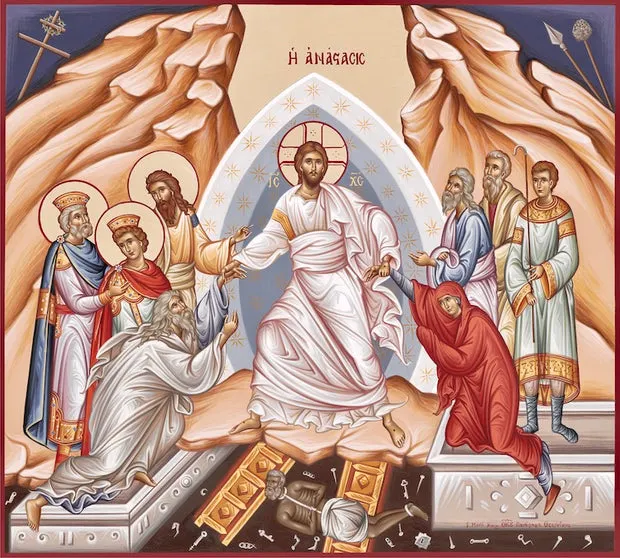
Icon of the Anastasis, or Resurrection
The harrowing of Hel
No story of heroism is complete without a trip to the underworld; God of War gives us two. The Norse underworld, Helheim, is a frozen wasteland of misery, the abode of those who died inglorious deaths. While the lucky war-dead are carried on Valkyries' wings to Valhalla, to enjoy an eternity of feasting, fighting, and (use your imagination), the souls of the unfortunate majority are consigned to gloom and torment. Twice, Kratos finds himself in this stark and unforgiving realm, contending with foes who would be all too happy to keep him there; it is the first descent into Hel which interests me, for some of its interesting parallels to the Christian account of the Resurrection.
The occasion for Kratos's journey into the underworld comes when Atreus falls ill, a lethal consequence of his divine nature trying to assert itself over a mind which believes that he is merely human. Kratos brings him to the witch-goddess Freya, who warns him of what the cure will require: the heart of the gatekeeper of the Bridge of Death, a monster who corrals the souls of the dead in Helheim. As he makes his preparations- retrieving weapons from his past which had lain buried- he is haunted by apparitions of Athena, who goads him: he will never escape what he has done, never change who he is. He brushes past her and makes the journey; he overcomes the gatekeeper, taking its heart, and opens the gates of Hel from the inside. Returning to Midgard, he delivers the cure to his son; it is at this point, as they are about to set off, that he tells Atreus the truth about his divine heritage.
I am wary of seeking patterns where none exist, but I don't think it's too controversial to mark this as a variation of the archetypal descent into Hades (legend has it, if you say this phrase three times in front of a mirror, Joseph Campbell will appear and give you a lecture on The Golden Bough). This idea casts a very long, very deep shadow across the history of human storytelling; we cannot seem to resist the motif of descending into the underworld to retrieve something lost but essential, then returning, altered somehow, to the world above. There are many possible explanations for this. Perhaps it is purely psychological; it is a useful narrative illustration for the process of personal growth through the confrontation with adversity. Or perhaps there is something deeper at work. The Christian position would, I think, be something like this: we are endlessly fascinated by this motif because, in all its forms, it is a retelling of something that really happened, something which transcends time and space in its profundity, and which is engraved deep into the foundation of the created order: the conquest of death by the Son of God. As Saint Peter puts it:
He was foreknown before the foundation of the world but was made manifest in the last times for the sake of you who through him are believers in God, who raised him from the dead and gave him glory, so that your faith and hope are in God.
1 Peter 1:20-21
Having died on a Roman cross, Christ's body is placed in a tomb, while his soul descends into the realm of the dead. There is a tradition which has been neglected by much of Western Christianity, but which is still alive and well in the East, and one which I dearly love: this is the harrowing of Hell, and it would be thoroughly at home in the world of God of War. As the tradition holds, Christ's descent into underworld was an act of overwhelming force against the powers of evil; this is best illustrated by the icons of the Resurrection, which frequently depict Christ breaking down and trampling on the gates of Hell, with his cloak billowing upwards from the sheer impact of his landing. Keys, bolts, locks, and screws are strewn about from the wreckage of the gates. Beneath his feet is an emaciated, corpse-like figure who has been bound by neck, hand, and foot; this is Death, the awful scythe-carrying spectre of the battlefield and the sickbed, now defeated and disgraced forever. Not content with overthrowing the ultimate enemy, Christ also takes two people by the wrists, raising them from their tombs whether they like it or not; these are Adam and Eve, the first of humanity to fall, and the first to be rescued from the power of death. Having contended with death and emerged victorious, Christ then leads the souls of the dead out of Hell in a triumphal procession, carrying aloft as a banner the very cross on which he was crucified, bringing them into the Kingdom of Heaven. As Saint Athanasius of Alexandria writes:
Death came to His body, therefore, not from Himself but from enemy action, in order that the Savior might utterly abolish death in whatever form they offered it to Him. A generous wrestler, virile and strong, does not himself choose his antagonists, lest it should be thought that of some of them he is afraid. Rather, he lets the spectators choose them, and that all the more if these are hostile, so that he may overthrow whomsoever they match against him and thus vindicate his superior strength. Even so it was with Christ. He, the Life of all, our Lord and Savior, did not arrange the manner of his own death lest He should seem to be afraid of some other kind. No. He accepted and bore upon the cross a death inflicted by others, and those others His special enemies, a death which to them was supremely terrible and by no means to be faced; and He did this in order that, by destroying even this death, He might Himself be believed to be the Life, and the power of death be recognized as finally annulled.5
Christ left it to his enemies to decide on the most agonising and horrible punishment to inflict upon him; he did this, Athanasius says, to prove that there was nothing they could do to him which he could not overcome. Death on a cross- an instrument of torture which exemplifies the worst extremes of human cruelty- was nothing. "Do your very worst," declares Christ; "I am stronger." Thus the powers of Hell brought about his death, thinking they had struck a blow against all that is good and right in the world; perhaps they had time to realise their mistake before they beheld the Son of God falling with meteoric force upon their heads.
If this is the truth- and I believe it is- then it is no wonder we cannot stop telling and retelling this story in a thousand variations. It would resonate through time and consciousness and leave an indelible imprint, an impact crater from which countless smaller narrative threads radiate. The notion of a descent into the underworld (and a triumphant return from it) would inspire and enchant because each time it appears, it recapitulates the victory that lies at the heart of all things: the Son of God (who is also the Danielic Son of Man, the true archetype of humanity, and everything we are meant to be), defeating death itself, rescuing the captives of Hell, and returning to life to be crowned with glory.
Fording the river
One final consideration in parting. Kratos and Atreus conclude their journey, having reached the summit they have striven after all this time; and release Faye's ashes to the wind. The beauty of the moment is hard to overstate, but it is bittersweet. They have nothing left of her now but memory. This is the problem faced by all the heroes of Homer's Iliad, which Kratos, as a Spartan, would undoubtedly have known: death is final, and this world is the only one which offers glory, consolation, or hope. At the funeral of Hector, the Trojans weep, for he is gone forever, and will not be returned to them:
When the young Dawn with finger tips of rose made heaven bright, the Trojan people massed about Prince Hektor's ritual fire. All being gathered and assembled, first they quenched the smoking pyre with tawny wine wherever flames had licked their way, then friends and brothers picked his white bones from the char in sorrow, while the tears rolled down their cheeks.6
Glory flares bright for a moment, and passes from the world, which is left darker than before. Love, also, can give its warmth only for a time. Sooner or later death will come, and none return from the land beyond the River Styx. The hero of the ancient world was, like all men and women, haunted by time, the herald of the end of all things; what made him a hero was that he fought harder against time than most others, and carved out for himself a place of fame (or infamy) in the memory of his people. But that could be his only lasting reward: memory.
I have talked about the Resurrection, and paid particular attention to its power as an archetypal story. For most people, that is all it is. I was once in that same position: a beautiful story, and one which surely brings comfort to people, but it could not possibly be true. I have since had to revise that assumption. Something very significant happened two thousand years ago; human history was knocked on its side by a tremendous force, and everything changed in the wake of the collision. It all revolved around the great gravity of an impossible story: a man who, to hear it told, had been killed, only to conquer death. To those who loved him in life, this meant that there was no more need for fear. Something had entered into the world from beyond its walls, and brought with it the promise of an eternity of love and glory and all those things which seem so fleeting and smokelike in these vanishing years of human life. Yes, it is a story, and a beautiful one: perhaps it is also true. Perhaps death is defeated, and there is more than memory.
For further consideration
A helpful primer on the world of the Norse gods:
Norse Mythology for Smart People
An explanation of common features in icons of the Resurrection:
Orthodox Road | Christ's Descent into Hell