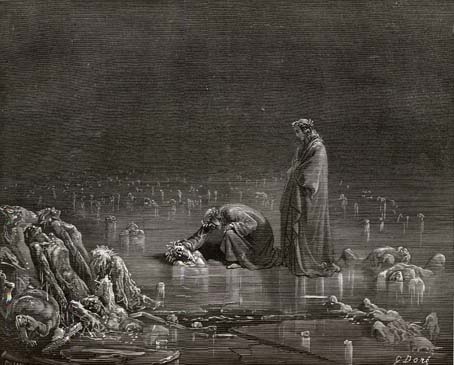
Decline in the last days
Reflections on 2 Timothy 3:1-9
A few weeks past, I was looking at the day's epistle reading from the lectionary in my Bible. It came from Saint Paul's second letter to Timothy. As I read, I started jotting down some thoughts; as tends to happen, this then turned into a longer meditation on how we see the world, and how modern technology hinders our moral efforts and enables our decline. Given our present anxieties about what the future may bring, I thought it would be worth putting it out as an article, if only as a help to myself to get my own thoughts in order. This is the passage:
But understand this, that in the last days there will come times of difficulty. For people will be lovers of self, lovers of money, proud, arrogant, abusive, disobedient to their parents, ungrateful, unholy, heartless, unappeasable, slanderous, without self-control, brutal, not loving good, treacherous, reckless, swollen with conceit, lovers of pleasure rather than lovers of God, having the appearance of godliness, but denying its power. Avoid such people. For among them are those who creep into households and capture weak women, burdened with sins and led astray by various passions, always learning and never able to arrive at a knowledge of the truth. Just as Jannes and Jambres opposed Moses, so these men also oppose the truth, men corrupted in mind and disqualified regarding the faith. But they will not get very far, for their folly will be plain to all, as was that of those two men.
2 Timothy 3:1-9
This passage of Scripture concerns the "last days", which has always been a thorny issue to write on. Search for this phrase online and you will find hours upon uncountable hours of hysterical commentary on eclipses, numerology, and the politics of the Middle East. I will not entertain any of that here. I think that no discussion of the end times should be undertaken without first observing that we have been in the end times since Christ's resurrection, two thousand years ago. This particular passage, however, is specifically eschatological: it concerns the period immediately leading up to Christ's return and the end of history. Those are the days after which he will reveal himself to the world in power rather than humility, riding on a war-horse (Rev. 19:11) rather than a donkey (Mark 11:6-8; Matthew 21:4-8; Luke 19:32-36). There are many places you could go with this passage; here, I would like to focus on the assumptions it makes about our destiny as human beings.
Destiny and narrative
The civilisational metanarrative with which I grew up was one of steadily increasing technological progress. I did not have to seek it out; it was implicit in nearly everything I read, heard, and watched. It was fostered by Doctor Who, Star Wars, and all the science fiction paperbacks I could find in the school library: I recall enjoying one series about a crew of precocious children who travelled around the galaxy in a spaceship made from the fossil of a giant ammonite. Without knowing it, I had acquired an implicit belief that the measure of a society could be found in its technological prowess. Had it reached certain milestones- the wheel, gunpowder, space travel? Likewise, I believed, without having set out to believe, that our destiny as a species was to overcome our planetary, and then our sidereal, limitations- we would first conquer other planets, and then proceed to other stars.
But even then there was a shadow behind all this. I remember, at around age eight or nine, being very distressed by the idea of the heat death of the universe- it seemed so unfair that everything was just going to end in some great cosmic catastrophe. Similarly, a few years on from this, I found myself trying to square my love of science fiction with the first real philosophical problem I ever wrestled with: the futility of action in a meaningless universe. Say we managed to become an interplanetary civilisation. What then? Spread to other star-systems? To other galaxies? The stories I loved held these things to be the final frontier of human exploration, yet I found myself wondering what the ultimate value of any of it could be. Once a civilisation had done this, I felt, there would be nothing meaningful left to do. I came to see the possibility of achieving faster-than-light travel- a prerequisite for nearly all science fiction- as a very dangerous one, as there was nothing after that to fill the void it would leave; crack the problem, and you might render all future human effort meaningless. Even the conquest of death itself would not be a balm; with nothing left to strive towards, it could offer nothing more than an eternity of zipping about between pointless diversions and chitchat.
This understanding of human destiny- the "progress" view- permeates much modern media, though its bleaker implications do not tend to be given as much air. It is advocated for by the technocrats of Silicon Valley, and their phalanxes of investors who are endlessly fascinated by the fluctuating trends in the digital space (first it was "blockchain", then it was "metaverse", now it is "AI"- whatever next?). It is one of the two major metanarratives striving for dominance in the public consciousness of the secular Western world. The other is the "extinction" view, which holds that human beings are a blight on Mother Earth, and that our desire for technological mastery over the facts of life can only come at the expense of our world's natural resources; the danger (or, to some people, the hope) is that our species will ultimately reach a crisis point and go extinct. This latter view, I think, is waxing, while the former is waning; talk about "sustainability" is far more common in the public square than talk about "progress". I would regard the extinction view as much the darker of the two. Its implications are clear: if humanity is guilty of crimes against the planet which sustains it, then humanity is the enemy, and must be treated as such. It is from this bitter root that we see the flowering of discussions about degrowth, and anti-natalism, and placing hard limits on the size of the human population: perhaps five hundred million would be enough.
It should go without saying that I am not particularly enthused by either view. They both have cogent elements: I think that exploration and progress are, in fact, good things, and also that as stewards of this creation we must take care not to abuse it. However, if either of these views are taken as a total account of the human story, they will exact in the end a terrible cost. Progress for the sake of progress is not merely pointless, but destructive; it cannot help but end in the kind of sinister ideology we find espoused by C.S. Lewis's character, the scientist Weston, who has forgone all illusions of morality in favour of an utterly amoral scientism, and does not much care if the inhabitants of other worlds are destroyed if only mankind may endure.1 Likewise, we must eschew any worldview which likens humanity to a cancer, or a virus, or a parasite (I have heard all three in my brief time on this earth); one cannot hold such a view and still retain any notion of the dignity of human life, which underpins all discussion about rights and international law. The reason these worldviews fail is because they are both, at base, naturalistic; they cannot offer any higher meaning because this universe is all that exists, and so they must cobble meaning together from nothing but physical components. This enterprise is doomed to failure, particularly in the realm of ethics. The principle that human life has value is not self-evident from within a naturalistic framework, which cannot qualitatively distinguish a human being from any other form of life (such as a cancer, a virus, or a parasite); this ethical principle must be placed on the kind of ground which secular philosophy cannot offer, and carefully guarded thereafter.
The Pauline alternative
At first glance, Saint Paul's meditations in the passage above may seem more at home in the "extinction" camp. He is pessimistic about the future state of humanity: he foretells difficult times characterised by moral decline, self-indulgence, and anarchy. The loves of that last generation will be selfish and greedy loves, bound up in money and self-admiration. They will not look outward, to the world beyond them and the people around them, those things which should be our foremost responsibilities; if they look anywhere they will look inwards, at their own wants, though many will not do any looking at all, and be driven blindly on by their passions.
The similarity, however, is only skin-deep. The Pauline metanarrative is one which has both a foreground and a background. The foreground may be one of cruelty, debauchery, and apathy, but in the background is God, the transcendental reality which is going ignored. The two competing worldviews which I explored above, by contrast, are all foreground. They have no depth. There is nothing going on behind the scenes, as it were; all action takes place against the blank, featureless wall of secular materialism. In neither the progress nor the extinction narratives can we find value or purpose beyond the purely subjective.
Paul's worldview does not share this problem. Writing to Timothy, he sees a purpose behind human nature which is going unfulfilled. He contends that in the last days, we will see greater and more blatant neglect of this purpose, and active scorning of it as well; but, crucially, that purpose exists. There may be dereliction of duty, and many posts abandoned, but those duties and those posts are assigned by a higher authority (I think Paul would have approved of the martial metaphor). This higher authority is not a thing located in the world, nor is it an idea or an abstraction; it is the reason that there is such a thing as a world, as an idea, as an abstraction. It is what causes being to be, while it itself transcends all being and all comprehension. It's the thing we fashionable moderns make a point of dancing around, and go to such lengths to avoid acknowledging; I think of this every time I hear somebody bring up simulation theory, or talk about how "the universe" has a plan for them.
Looking back on my teenage self, trying and failing to find ultimate meaning in a universe which stops at the bounds of empirical science, it's clear what I was missing. Naturally, if you'd tried to talk to me about Jesus at that point, I probably wouldn't have listened; but I think I would have benefited from being walked through the metaphysical issues at the heart of my modern, secular assumptions. It leads me to wonder how many other children and young adults are in a similar position today, having been raised on a diet of media that cannot help but presuppose all the things we have explored, and having grown up not knowing any other way to think about the universe than as a blind and purposeless machine.
Fording the river
Metaphysics aside, I think there are two principal points to be taken from Saint Paul's writing here. Firstly: in verse 7, he speaks about those who are "always learning and never able to come to the knowledge of the truth". Reading this verse, I couldn't help but think of the absurd volume of information which we have been accustomed to consume on a daily basis. We have available to us an inexhaustible well of things to learn; many of these are good things, such as the Greek lessons I've been neglecting. Even so, I'm not convinced that this limitless access to information has made us wiser. Navigating the online world requires immense powers of discernment, particularly given the fact that the platforms we use to navigate it are designed to facilitate addiction; the individual user is hardly fighting on level ground against the billions of dollars that have been spent researching how to manipulate our psychology in this manner. Even though I make very little use of social media, I know for a fact that I don't have nearly as much discernment as I need, and I have to make a conscious effort not to reach for my phone when I have a minute to spare; for those people who have become accustomed to the "doomscroll" as a normal part of life, the effort required must be almost superhuman.
The conspiratorially-inclined part of me wonders if this isn't deliberate. Knowledge, as we learn in the book of Genesis, isn't always good, and not without reason were we commanded not to eat of the fruit of that tree; the technology which results from this facilitates our worst impulses as often as it does our best. Pardon me while I don the tinfoil hat: is it really an accident that so many of those devices which are causing us such trouble are marked with the symbol of a bitten apple?
The second point which I would like to explore comes in the final verses of this passage. Verses 8 and 9 give us a reference to the book of Exodus. Jannes and Jambres, per the intertestamental Jewish tradition, were the court magicians of Pharaoh. The interesting thing about these two is that they were able to duplicate three of Moses' miracles (among them the first two plagues, which I'm sure Pharaoh appreciated- as if there weren't already enough frogs to deal with!). This may be a tenuous link, but this left me thinking of Arthur C. Clarke's observation that any sufficiently advanced form of technology is indistinguishable from magic. I would differ from Clarke in that I don't recognise the conventional distinction between natural and supernatural, but I think there is something to be said for the relationship between technology and magic. Both, fundamentally, are efforts to extend and exert our control over the world; it is also worth noting that both tend to invite compromise on one's ethics in the pursuit of that effort. The search for mastery over the forces of nature may be pursued through technological or occultic means; there is far less distance between the mad scientist and the sorcerer than typically imagined.
This is especially relevant today, at the advent of so many strange machine intelligences whose creators are engaged in the attempt to build their own gods (I wish I were exaggerating; this is the language you will hear them use). In the nascent field of AI, the lines between the technological and the occultic has already begun to blur. Perhaps, given the proliferation of artificial intelligences tailored for occultic endeavours (just type "ai and occultism" into your search bar and you'll see what I mean), that line will soon be invisible. I must pay lip service to the genuinely good things which are being made possible by machine learning, particularly in the medical sciences; that said, I think that such advances are the exception rather than the rule, and the principal effect of AI will be to hasten our moral decline. To give a contemporary example: in my own country, we have recently seen the government prohibiting users of a certain billionaire's pet AI from using its resources to make indecent images of people. The raging debate over this has been one of free speech. I will not weigh in on that here; I will only remark on how sinister it is that the technology to feed our worst impulses should have become so convenient. Again, I am led to wonder: who benefits from this? Who would be happiest to see us tread further down this dark path?
Far be it from me to start looking for signs in the heavens, but I think that Saint Paul's warnings have never been more prescient. But it is not just a warning he offers; there is also a way out. We do not need to be caught in this trap. Our modern, secular, machine-minded culture insists on cluttering our visual field with technological distractions, all designed to ensnare us in destructive patterns of behaviour. Paul directs our attention to something above and beyond the clutter, from the foreground to the background, so that we are looking at the transcendental purpose that underlies our lives in this world. Let us all bear that in mind, and make every effort to follow where he is pointing; I suspect that it will not get any easier as time goes on.
For further consideration
A couple of interesting articles on the intersection of religion, occultism, and AI research:
Silicon Valley’s Obsession With AI Looks a Lot Like Religion | MIT Press
A Demon in a Box? Unspooling the Dark Mythology of AI | MIT Press
All Bible citations are from the English Standard Version unless specified otherwise.